

What to do when a client goes quiet
Before you assume the worst. A calm plan for the silence, with the exact words to send.

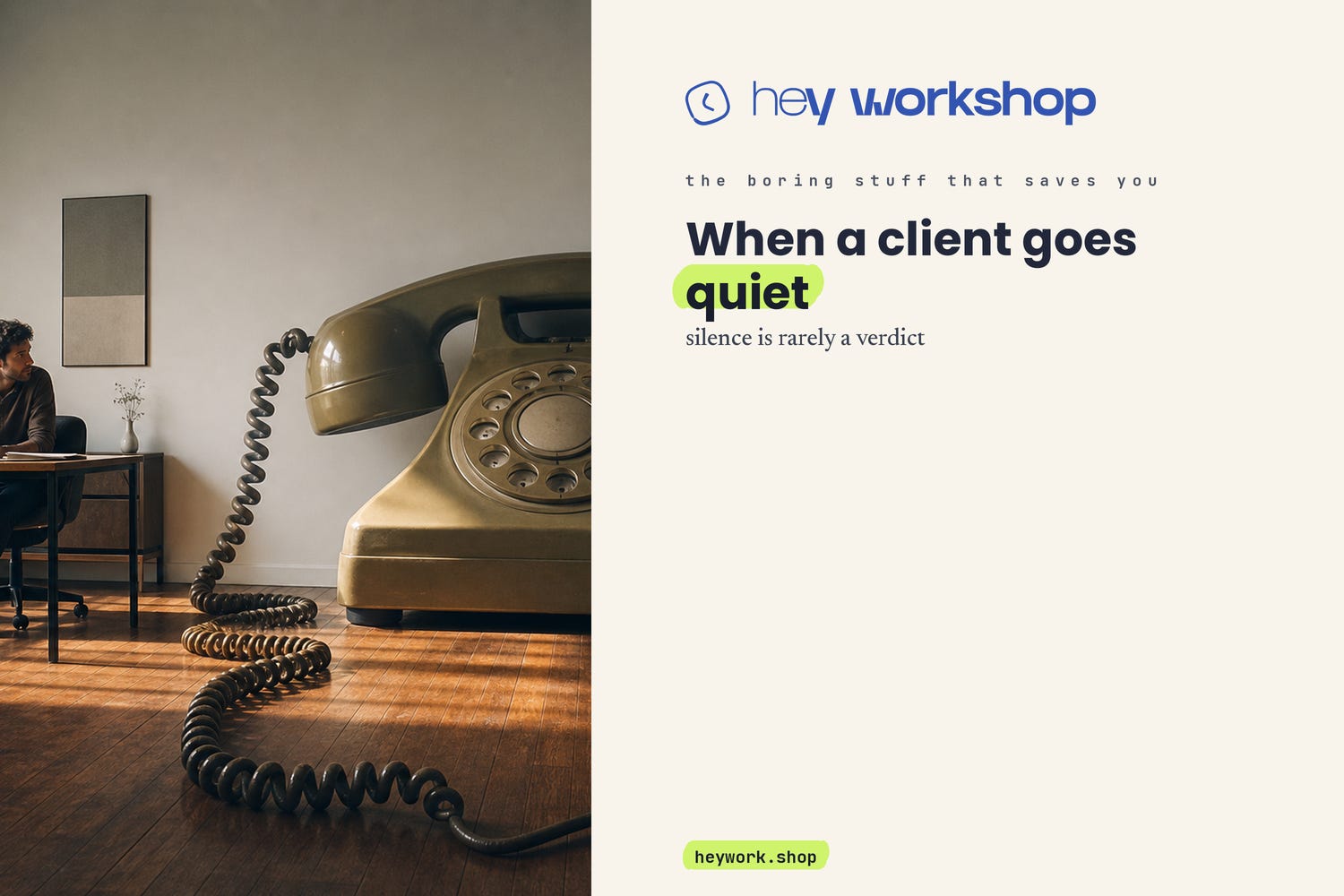
You sent the work. Or the proposal. Or the “here is where we are, just need your go-ahead” email. And then, nothing.
A day passes. Then two. You start refreshing your inbox like it owes you money. You reread your last message hunting for the thing you said wrong. By day three you have quietly decided they hate the work, they hate you, and you were never cut out for this.
Take a breath. A quiet client is almost never the story you are telling yourself.
The silence is usually about their week, not your work
Here is the part nobody says out loud: most of the time, the client is just busy. Their kid is sick. Their boss dropped a fire drill on them. The budget got frozen and they are a little embarrassed to say so. The work you sent is sitting in a tab they keep meaning to open.
Heidi Turner, who writes Happy Freelancing, describes the freelance year as cycles, including the stretch where you start wondering if all your clients “have fallen into a collective coma.” Every freelancer knows that quiet. It feels personal. It rarely is.
And when a client does drift off for good, it is usually not about the last thing you sent. J. Alex Greenwood, who writes All the Fits That’s News, puts it well: people go quiet “not because the last thing was unbearable, but because the accumulation was.” Silence is slow math, not a verdict on your latest deliverable.
So before you rewrite your whole personality, assume the boring, human explanation first. Then follow a plan instead of your panic.
Decide your follow-up rhythm before you need it
The reason a quiet client turns into a 2am spiral is that you are improvising. You never decided in advance what you would do, so every day of silence becomes a fresh little argument about whether you are being annoying.
Fix that once. Here is a simple three-touch rhythm you can reuse on every project.
Touch one, a gentle nudge (3 to 4 days of silence). Short, warm, easy to answer. Restate the one thing you need and make saying yes take ten seconds.
Hi [name], just floating this back to the top of your inbox. Whenever you have a moment, I need a yes or no on [the one thing] to keep us on track. No rush if this week is full, just let me know.
Touch two, a value check-in (about a week later). Do not send another “just checking in.” Give them something small and useful, so the message is a gift and not a guilt trip.
Hi [name], no pressure on [the thing] still. While it is on pause, here is a quick idea I had for [their goal] that you can use either way. Happy to pick back up whenever you are.
Touch three, the graceful close (about two weeks in). This one protects your calendar and your dignity, and it keeps the door wide open. Rishika Baga, a freelancer quoted in Sakshi Agrawal’s The Freelance Handbook, takes exactly this posture: she follows up, asks for feedback, and if none comes, “silence is often a no.” You can name that kindly.
Hi [name], I am going to assume this one is on pause for now and free up the time so I can commit it elsewhere. The door is wide open, so just say the word when you are ready and we will pick it right back up. It was good working with you.
Notice what the close does. It is not a threat and it is not a sulk. It gives them an easy out, gives you your headspace back, and often, funnily enough, it is the message that finally gets a reply.
Protect your own head while you wait
The waiting is the hard part. Agrawal cites a 2024 Leaper’s study that found 72% of freelancers had been ghosted, and 60% said it hurt their mental health. You are not soft for feeling it. You are normal.
Two things help. First, reframe it the way Rishika does: “it’s not about my worth, it’s about fit.” A quiet client is data about a match, not a grade on you as a person. Second, do the thing Turner points to: take one small action, because “taking action, even when the action is small, can remind you that you have some control.” Send the next pitch. Work on your own thing. Momentum beats refreshing.
Then quietly prevent the next one
You cannot ghost-proof a client, but you can make the silence far less likely, and far less scary, by setting the terms at the start.
Agree on a rhythm up front. “I will send updates every Friday, and I will need your feedback within two business days to keep the timeline.” Now silence has a shape, and you both know what normal looks like.
Get a deposit before you start. A client with money down goes quiet a lot less often, and if they do, you are not working for free while you wait.
Qualify harder before you say yes. Agrawal’s freelancers both landed on the same lesson: use a short pre-call questionnaire to check budget, goals, and fit before you commit. The clearest clients ghost the least.
Paperwork is not admin. It is peace of mind. The boring stuff you set up on day one is exactly what saves you on day ten.
The one thing to do today
Open a blank note and write your own three-touch follow-up, in your own words, for the next time a client goes quiet. Nudge, value check-in, graceful close. Save it somewhere you will find it fast. The next time your inbox goes silent, you will not spiral. You will open the note and send touch one.
That is the whole trick. Not being unbothered. Being ready.
If this helped, subscribe so the next one finds you, and come see the plain, do-the-work playbooks and tools we are building at heywork.shop. Free things first, no subscription, and everything you make stays yours.
Your turn: what has actually gotten a quiet client to reply for you? Tell me in the comments. I read every one.