

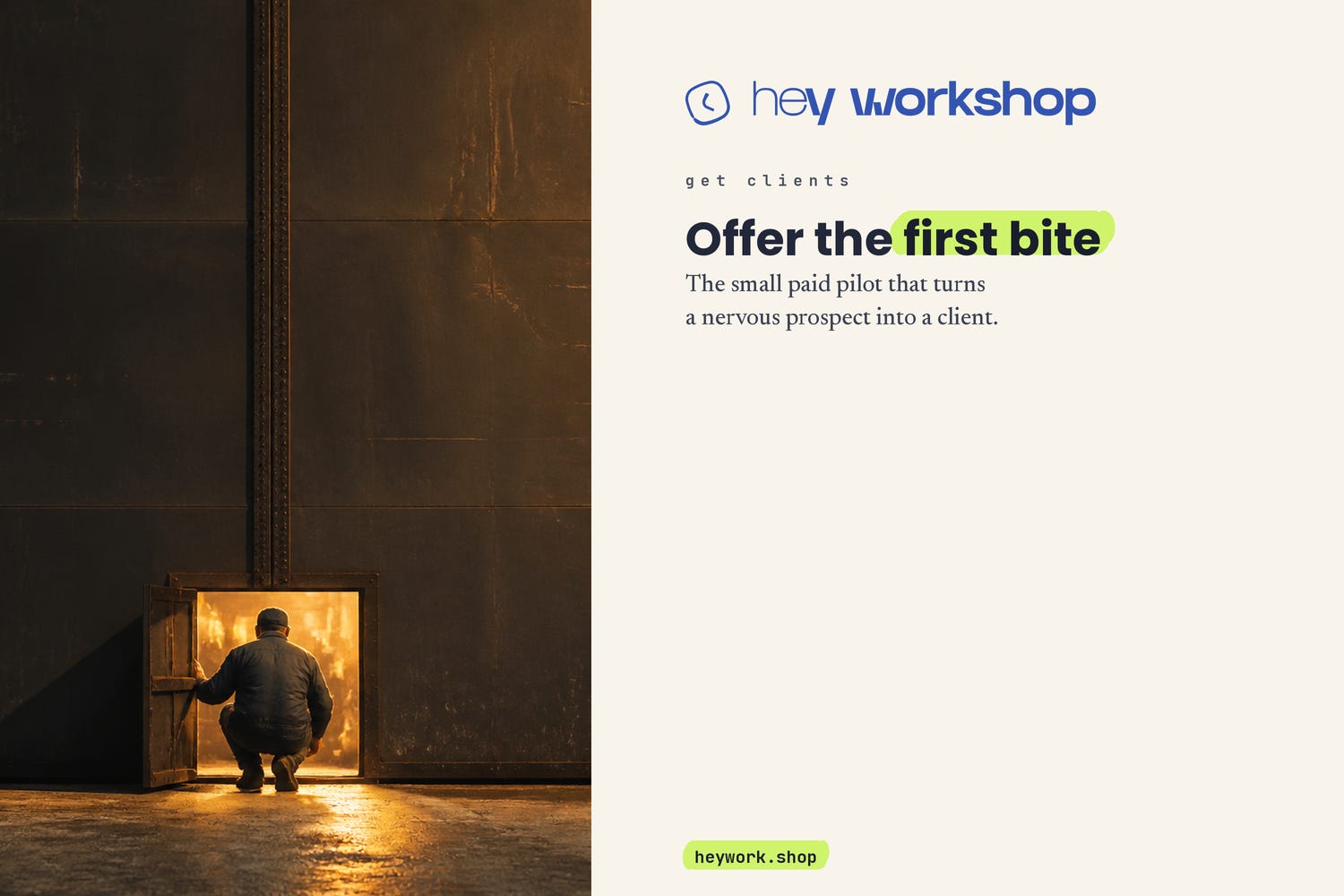
Stop pitching the whole project. Offer the first bite.
The small paid pilot that turns a nervous prospect into a client.

You sent the proposal. Twelve pages, three phases, six thousand dollars. And then nothing.
It is easy to read that silence as a verdict on you. It usually is not. It is a verdict on the size of the ask.
Look at what you asked a person who barely knows you to do. Hand over thousands of dollars, weeks of their calendar, and the risk of looking foolish in front of their boss if you turn out to be a dud. That is not a price problem. That is a trust problem, and no amount of polish on page seven of the proposal fixes it.
So make the first thing you sell smaller.
What a first bite actually is
A pilot is one small piece of the real work. Paid, finished in a few days, and useful on its own even if you never work together again. It is not a discovery call. It is not a free audit. It is a real deliverable at a real price.
Developer: rebuild one page, not the site. Copywriter: the homepage headline and the first two sections, not the whole site. Designer: one set of social templates, not the brand. Virtual assistant: one week of inbox triage, not a retainer. Photographer: one product, not the campaign.
Small enough that saying yes is easy. Real enough that they can see how you work.
Paid, not free
The instinct is to make the first thing free. Resist it. A free sample makes you an auditioning vendor. A small paid project makes you a supplier being trialed, and those are two completely different rooms to stand in.
Melissa at Melissa | Start Freelancing! warns against giving away hours of unpaid labour to prospects who have not earned it. Her rule of thumb is that anything you do upfront should take an hour or two, no more. The paid pilot is the honest version of that idea. You still lower the risk for them, but you stop paying for the privilege of being considered.
Where the first bite leads
In a roundup by Grace Abbott , the designer Jillian Alexa describes her path with one client in three moves: referred, then a paid VIP day, then a retainer. That middle step is the whole point of this piece. She did not go from stranger to retainer. She went from stranger to one small paid thing, and the retainer followed the proof.
And the numbers behind a first year are calmer than they look from outside. Sarah Ashton went back and logged every lead from her first year of freelancing, the ghosts and the dead ends included. Thirty nine genuine leads in twelve months. Her conclusion was that the year had not really been about counting clients at all. It was about conversations, and about being in enough rooms for the right people to find her. A first bite is the cheapest way to turn one of those conversations into work.
The words to use
Send this instead of the twelve page proposal.
“Before you commit to the whole thing, let’s do one piece of it. I will [one specific deliverable] by [date] for [price]. It is yours to keep either way. If you like how it goes, we can talk about the rest. If not, you still have something you can use and we part on good terms.”
Four things make it work. One deliverable, so there is nothing to argue about. A real date, so they can picture it done. A real price, so nobody is doing charity. And a clear line about what happens next, so the yes does not feel like a trapdoor.
One more thing, and it is the part people skip. Deliver the small thing better than the price deserves. Not by working three times as long, but by being easy: reply fast, send it early, explain what you did in plain words. The pilot is not really a test of your craft. They mostly assume you can do the work. It is a test of what you are like to work with.
Your next step
Take your usual offer and cut it down to the smallest piece that still helps somebody. Put a number on it that you would happily accept from a stranger. Then send it to one person this week. Not a campaign. One person.
You are not lowering your standards. You are lowering the risk of saying yes to you, which is the only thing standing between a nice conversation and a paying client.
What is the smallest piece of your work you could sell on its own? Tell me in the comments and I will help you shape it.
If this helped, subscribe. We publish plain, honest steps for people building a business of one, and more tools live at heywork.shop
Thanks o much for mentioning my article in this, such a lovely surprise to come across, and I really loved how you picked up on the wider point behind the numbers too!